169199. 리코챗 로봇
문제
https://school.programmers.co.kr/learn/courses/30/lessons/169199
프로그래머스
SW개발자를 위한 평가, 교육, 채용까지 Total Solution을 제공하는 개발자 성장을 위한 베이스캠프
programmers.co.kr
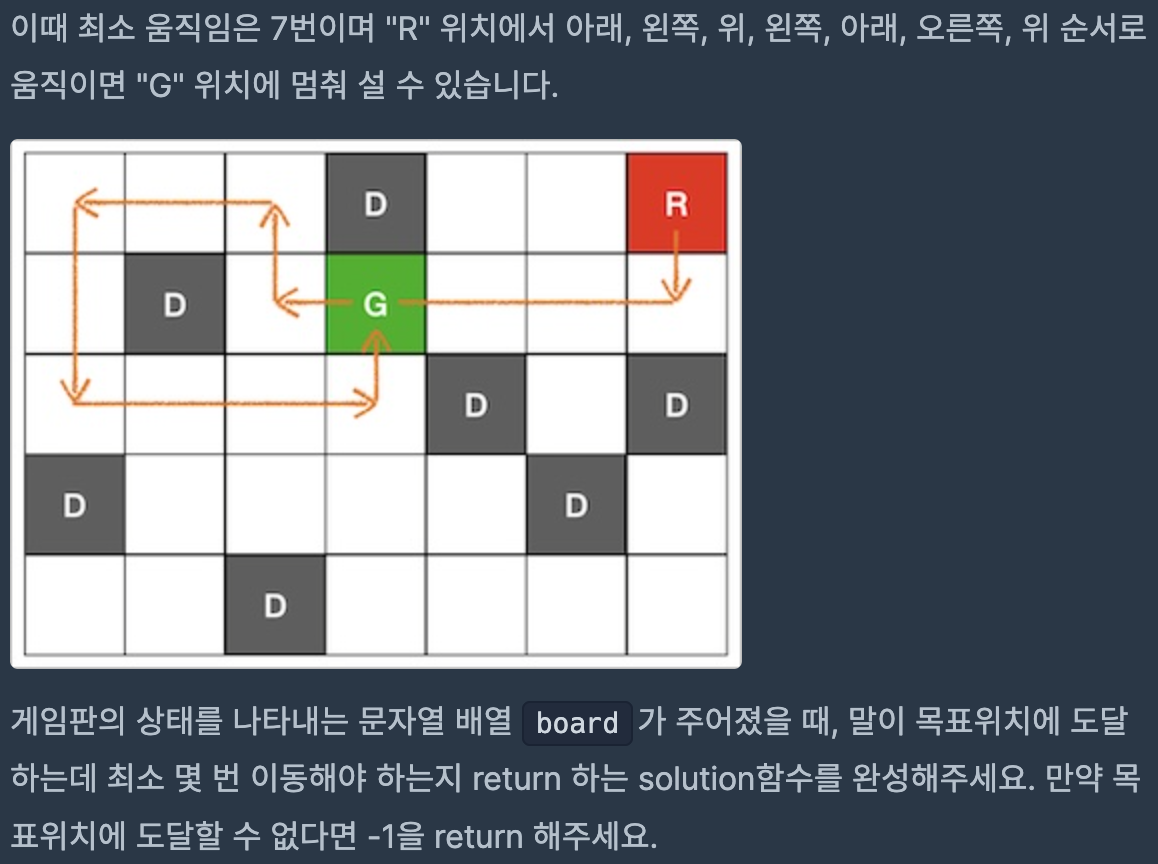
제한사항

풀이
import java.util.*;

class Solution {
    public int solution(String[] board) {
        int answer = 0;

        int n = board.length;
        int m = board[0].length();

        char[][] boardMap = new char[n][m];
        int[] start= new int[2];
        int[] end= new int[2];

        for(int i =0;i< n;i++)
            for(int j =0; j<m;j++) {
                char position = board[i].charAt(j);
                if(position == 'R')
                    start = new int[]{i,j};
                else if(position == 'G')
                    end = new int[]{i,j};

                boardMap[i][j] = board[i].charAt(j);
            }

        boolean[][] visited = new boolean[n][m];

        System.out.println("start: " + start[0] + "," + start[1]);
        answer = bfs(visited, boardMap, start, end);

        return answer;
    }

    int bfs(boolean[][] visited, char[][] boardMap, int[] start, int[] end) {
        Queue<int[]> queue = new LinkedList<>();
        int[][] dir = {{-1, 0}, {1, 0}, {0, -1}, {0, 1}};
        int n = boardMap.length;
        int m = boardMap[0].length;

        queue.offer(new int[]{start[0], start[1], 0});

        while(!queue.isEmpty()) {

            int[] cur = queue.poll();
            int curRow = cur[0];
            int curCol = cur[1];
            int moves = cur[2];

            if(curRow == end[0] && curCol == end[1])
                return moves;

            for(int i = 0;i<4;i++) {
                int nextRow = curRow;
                int nextCol = curCol;


                while(nextRow+dir[i][0] >= 0 && nextRow+dir[i][0] < n &&
                     nextCol + dir[i][1] >= 0 && nextCol + dir[i][1] < m &&
                     boardMap[nextRow+dir[i][0]][nextCol+dir[i][1]]!='D') {

                    nextRow+=dir[i][0];
                    nextCol+=dir[i][1];

                }

                if(!visited[nextRow][nextCol]) {
                    visited[nextRow][nextCol] = true;
                    queue.offer(new int[]{nextRow, nextCol, moves+1});
                }
            }
        }

        return -1;
    }
}
회고
BFS를 이용해 최단 이동 횟수를 구하는 문제였다. 일반적인 BFS에서는 한 칸씩 이동하며 방문 여부를 확인하지만, 이 문제에서는 로봇이 장애물이나 벽을 만날 때까지 계속 직진한다. 한 방향을 멈추지 않고 이동하는 코드는 아래와 같다.
while(nextRow+dir[i][0] >= 0 && nextRow+dir[i][0] < n &&
                     nextCol + dir[i][1] >= 0 && nextCol + dir[i][1] < m &&
                     boardMap[nextRow+dir[i][0]][nextCol+dir[i][1]]!='D') {

                    nextRow+=dir[i][0];
                    nextCol+=dir[i][1];

                }
여러 방향으로 이동하며 탐색을 하면서 방문 여부를 확인을 해야 무한 이동을 방지할 수 있다. 일반적인 BFS 문제는 한 칸마다 방문 여부를 확인하면 됐었는데, 이 문제는 어떤 방식으로 방문을 확인해야 할지 고민했었다. 근본적인 물음에서 고민이 해결됐다. 왜 일반적인 BFS에서는 한 칸 씩 이동하면서 방문을 확인했을까?
- 이동한 칸마다 경우의 수가 달라질 수 있기 때문이다.
- 방문한 칸이라면 뒤에 일어날 일은 알고 있기 때문에 고려하지 않아도 된다.
하지만 이 문제에서는 한 칸씩 이동해도 경우가 달라지지 않는다. 로봇은 벽이나 장애물을 만나기 전까지 방향을 바꿀 수 없기 때문이다.
그렇다면 중요한 건 이동 중 지나친 칸이 아니라, 로봇이 멈추게 되는 칸이다. 즉, 방문 여부 체크는 멈추는 지점(벽이나 장애물 앞)에서만 하면 충분하다.
좀 더 쉽게 생각하면, 이 문제는 일반적인 BFS에서 각 칸을 하나의 긴 통로로 연결된 형태로 생각할 수 있다. 긴 통로를 따라 로봇이 미끄러지듯이 이동하고, 끝에서 멈추는 순간에만 다음 탐색 가능성을 체크한다고 보면 이해하기 쉽다.